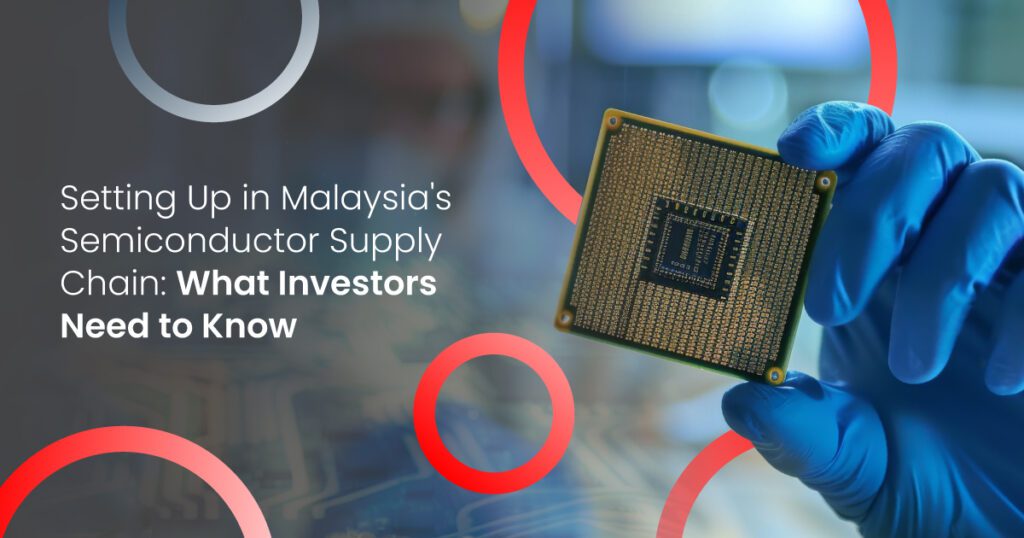
The global semiconductor industry is on a trajectory that few could have predicted even five years ago. Driven by the rapid proliferation of artificial intelligence (AI), electrification, and advanced computing, the sector is projected to become a US$1 trillion industry by 2030, according to McKinsey analysis. This monumental growth is fundamentally reshaping technology demand, global supply networks, and workforce requirements worldwide, creating significant opportunities for the Malaysia semiconductor supply chain as the country expands its role in advanced manufacturing, IC design, and regional supply chain resilience.
For foreign investors and multinational corporations (MNCs) looking to position themselves within this growth story, Malaysia has emerged as one of the most strategically compelling destinations in Southeast Asia. The nation has long been a cornerstone of the global ecosystem, particularly in assembly, testing, and packaging (ATP). However, the country is now undergoing a deliberate, policy-driven transformation that goes far beyond its traditional strengths to capture higher-value activities.
Under the National Semiconductor Strategy (NSS) and the New Industrial Master Plan 2030 (NIMP 2030), the government is actively building capabilities in integrated circuit (IC) design, advanced packaging, and digitally enabled manufacturing. For investors, the question is no longer whether the region is relevant. The focus has shifted to understanding how to seamlessly establish semiconductor operations in Malaysia. This comprehensive guide sets out exactly what corporate decision-makers need to know to navigate the regulatory landscape and achieve sustainable growth.
Malaysia Semiconductor Investment Snapshot
- Foreign ownership: Up to 100% generally permitted for manufacturing activities
- Common structure: Sdn Bhd
- Key regulators: MIDA, SSM, MDEC, Immigration Department
- Manufacturing licence trigger: RM2.5 million shareholders’ funds or 75+ employees
- Key incentive schemes: Pioneer Status, Investment Tax Allowance (ITA), Reinvestment Allowance (RA)
- Main semiconductor hubs: Penang, Kulim, Selangor, Johor
What Is Changing in the Malaysia Semiconductor Supply Chain Landscape?
The current transformation in the market is structural, not cyclical. The Malaysian Investment Development Authority (MIDA) has identified converging forces reshaping the sector: the AI-driven surge in demand for high-performance chips, global electrification initiatives, and the push towards advanced computing platforms requiring specialised components.
These forces are rewriting the rules of international trade. Geopolitical pressures and the global push for supply chain resilience have accelerated the movement of capital into Southeast Asia, positioning the country to capture a disproportionate share of Malaysia semiconductor investment 2026.
The shift is already well underway. The industry is moving rapidly up the value chain from standard ATP towards IC design and smart manufacturing systems. Initiatives like the ARM-Malaysia Strategic Cooperation have committed to training up to 10,000 engineers in IC design over four years. Concurrently, MIDA’s Special Taskforce-Talent Facilitation (STF-TF) convenes stakeholders across higher education and industry to align workforce development with operational needs. Established hubs like the Penang Science Cluster and Kulim Hi-Tech Park remain vital anchors, while emerging clusters in Selangor and Johor provide new avenues for expansion.
Can Foreign Companies Enter the Supply Chain?
Foreign participation is highly encouraged, with the government actively courting international expertise and capital to strengthen the semiconductor supply chain in Malaysia. Below are the critical considerations for international decision-makers.
Can a foreign company own 100% of a business in Malaysia?
Malaysia generally permits 100% foreign ownership for manufacturing companies, including semiconductor and technology-related businesses. While there is no universal paid-up capital requirement for all foreign-owned Sdn Bhd companies, businesses intending to undertake regulated manufacturing activities may become subject to additional capital and licensing thresholds under the Industrial Coordination Act 1975.
For example, companies applying for a manufacturing licence through MIDA may fall within the RM2.5 million shareholders’ funds threshold, depending on the nature and scale of operations.
What is the best company structure for an investor?
Most foreign technology firms incorporate as a Sendirian Berhad (Sdn Bhd), which is the equivalent of a private limited company. This structure provides full legal personality, limited liability, and the ability to apply for critical government incentives and licences. While a branch office is legally possible, it does not enjoy the same incentive access and carries greater legal exposure for the parent company.
Which locations are best for operational facilities?
The country offers several established zones tailored for high-tech manufacturing:
- Penang: The original technology hub, home to major players like Intel, Infineon, and Bosch, offering a deep talent pool and an established supplier ecosystem.
- Kulim Hi-Tech Park (Kedah): Designated specifically for high-technology industries, featuring significant land availability and attractive government incentives.
- Selangor (Shah Alam / Petaling Jaya / Cyberjaya): Highly suitable for IC design, R&D, and back-end operations due to its proximity to Kuala Lumpur and strong university talent pipelines.
- Johor: An emerging hub benefiting from cross-border synergies with Singapore and growing investments in advanced manufacturing.
What is the Malaysia Digital status?
Administered by the Malaysia Digital Economy Corporation (MDEC), the Malaysia Digital (MD) status is a government initiative that supports companies engaged in qualifying digital and technology-driven activities in Malaysia. Businesses involved in areas such as integrated circuit (IC) design, software-driven manufacturing systems, artificial intelligence, digital services, and advanced R&D operations may be eligible to apply.
Eligible companies approved under the Malaysia Digital framework may qualify for tax incentives, facilitation support, and duty exemptions, subject to prevailing approval conditions and incentive packages administered by MDEC.
The Malaysia Digital status may be particularly relevant to semiconductor businesses engaged in IC design, embedded software, AI-enabled manufacturing systems, and digital engineering.
Step-by-Step: How Foreign Investors Can Set Up Semiconductor Operations in Malaysia
Entering a highly regulated and capital-intensive sector requires a structured approach. Here is a practical roadmap for efficiently executing your market entry.
Step 1: Choose your entity type
Incorporate an Sdn Bhd to ensure full operational capacity and incentive eligibility. The Companies Commission of Malaysia (SSM) administers this process, which typically takes 1–3 business days once all documentation is prepared. Key requirements include appointing at least one director ordinarily resident in Malaysia, establishing a registered office address, and engaging a licensed company secretary. You can learn more on our Company incorporation page.
Step 2: Select the right location and industrial zone
Your location directly impacts land costs, available incentives, talent access, and logistics efficiency. Free trade zones (FTZs) and licensed manufacturing warehouses (LMWs) offer crucial customs duty exemptions on imported raw materials and components. Engaging a corporate advisor to assess site suitability is highly recommended before making real estate commitments.
Step 3: Apply for MIDA investment approval and manufacturing licence
Manufacturing entities with shareholders’ funds of RM2.5 million and above, or those employing 75 or more full-time staff, must obtain a manufacturing licence. Securing this approval unlocks access to major tax reliefs. Applications require comprehensive business plans, financial projections, and site information. Processing times typically range from 4 to 8 weeks.
Step 4: Apply for Pioneer Status or Investment Tax Allowance
Businesses undertaking promoted activities may apply for Pioneer Status or Investment Tax Allowance incentives, subject to MIDA’s approval criteria and assessment. Depending on the approved activity and investment profile, qualifying companies may receive statutory income tax relief or capital expenditure allowances.
Step 5: Hire and structure your workforce
Manufacturing companies operating under an MIDA manufacturing licence are generally expected to maintain a predominantly Malaysian workforce. Current approval guidelines commonly require that at least 80% of employees are Malaysian. They also include broader economic contribution criteria.
For example, management, technical, and supervisory (MTS) roles must represent at least 25% of total employment, or value-added activities must exceed 40%. Exact requirements may vary depending on the company’s industry segment, operational scale, technology intensity, and approved investment structure.
Step 6: Maintain ongoing compliance
Operational businesses must adhere to strict corporate secretarial requirements, including annual returns and board resolutions. Furthermore, audit and accounting obligations under the Companies Act 2016, monthly Sales and Service Tax (SST) filings, and statutory employee contributions are mandatory. Consistent MIDA reporting is also required to maintain active incentive status. Find out more on our Accounting & tax page.
Tax Incentives and Government Support
Malaysia offers a range of investment incentives designed to support high-technology manufacturing, semiconductor activities, and strategic industrial development. Major incentives administered by MIDA include Pioneer Status (PS) and Investment Tax Allowance (ITA), subject to approval and assessment criteria.
Eligibility is generally evaluated based on factors such as:
• technology intensity
• value-added activities
• capital investment levels
• industrial linkages
• workforce development
• R&D capabilities
• strategic economic contribution
Depending on the approved activity and investment profile, Pioneer Status may provide partial or full statutory income tax exemptions, while Investment Tax Allowance may offer qualifying capital expenditure offsets against statutory income over an approved incentive period.
Applications should generally be submitted before the commencement of commercial production or operational activities to preserve eligibility.
Building Your Workforce: Talent Rules and Regulations
The government has placed talent development at the core of NIMP 2030. Semiconductor employers must navigate specific human resources frameworks to remain compliant and competitive.
Local hire obligations
Manufacturing licences mandate a minimum proportion of local employees. Relying heavily on foreign labour at the operational level can jeopardise licence renewals and active tax incentives. The expectation is to build a sustainable local foundation while leveraging foreign expertise strategically.
Employment Pass processes
Foreign R&D specialists, engineers, and senior managers typically enter Malaysia via an Employment Pass (Category I, II, or III), subject to salary thresholds, contract duration, and approval requirements set by the Immigration Department of Malaysia and the Expatriate Services Division (ESD). Category I passes (monthly salary of RM20,000 and above) offer the greatest flexibility, including eligibility for dependant passes. Employers are generally expected to demonstrate the need for foreign expertise, particularly for specialised or senior-level positions where suitable local talent may not be readily available. Read our comprehensive Employment Pass guide for detailed criteria.
Statutory HR and payroll obligations
Employers are legally obligated to contribute to the Employees Provident Fund (EPF), the Social Security Organisation (SOCSO), and the Employment Insurance System (EIS) for eligible staff. Payroll must strictly comply with the Employment Act 1955. Partnering with a compliant local payroll provider mitigates the risk of inadvertent regulatory breaches. Review our HR & payroll page for operational support.
Key Business Support Services for Semiconductor Investors in Malaysia
Foreign semiconductor investors entering Malaysia often require more than incorporation support alone. Regulatory approvals, workforce planning, tax structuring, and ongoing compliance obligations typically involve coordination across multiple operational areas.
Depending on the company’s activities and expansion model, businesses may require support with:
• Company incorporation and corporate structuring
• MIDA manufacturing licence applications
• Employment Pass and immigration support
• Payroll and statutory HR compliance
• Accounting and tax compliance
• Corporate secretarial and governance obligations
• ESG and risk advisory for supply chain operations
Working with an integrated corporate services provider can help businesses streamline market entry, reduce compliance risks, and improve operational readiness during expansion into Malaysia’s semiconductor ecosystem.
Accelerate Your Market Entry with InCorp Malaysia
Entering a highly regulated market requires more than a sound financial model. It demands on-the-ground expertise, established regulatory relationships, and a compliance infrastructure that functions flawlessly from day one.
InCorp provides end-to-end corporate solutions tailored for foreign investors navigating the ASEAN landscape. From managing your initial Sdn Bhd incorporation and guiding MIDA licence applications to handling Employment Pass applications, expatriate hiring requirements and ongoing statutory compliance, our dedicated teams ensure your expansion is seamless, compliant, and optimised for sustainable growth.
Ready to execute your market entry strategy? Connect with our advisory team today to structure your operations for long-term success.
FAQs About Malaysia Semiconductor Supply Chain
- Yes. The country consistently ranks among the top global locations for output, supported by deep infrastructure, an established MNC presence, highly attractive government incentives, and rapidly expanding IC design capabilities.
- Securing a manufacturing licence typically takes between 4 and 8 weeks. This timeline depends heavily on the completeness of the submitted application and the specific promoted activity category the business falls under.
- Yes. A fully foreign-owned entity is eligible for Pioneer Status provided it meets MIDA's promoted activity criteria, fulfils minimum investment thresholds, and complies with local hiring guidelines.
- Launched under NIMP 2030, the NSS is a comprehensive, long-term blueprint designed to develop a globally competitive ecosystem spanning IC design, advanced manufacturing, packaging, and robust talent development.
- Most semiconductor manufacturing companies in Malaysia are required to obtain a manufacturing licence from MIDA if they meet specific thresholds under the Industrial Coordination Act 1975, including shareholders’ funds of RM2.5 million or more or employing at least 75 full-time staff. Licensing requirements may vary depending on the company’s activities and operational structure.
- Yes. Foreign semiconductor companies operating in Malaysia may hire expatriates for specialised engineering, R&D, technical, and senior management roles through the Employment Pass framework, subject to Immigration Department and ESD approval requirements. Employers are generally expected to prioritise local workforce development while demonstrating the need for foreign expertise in specialised positions.
Build Your Semiconductor Operations in Malaysia with Confidence
About the Author