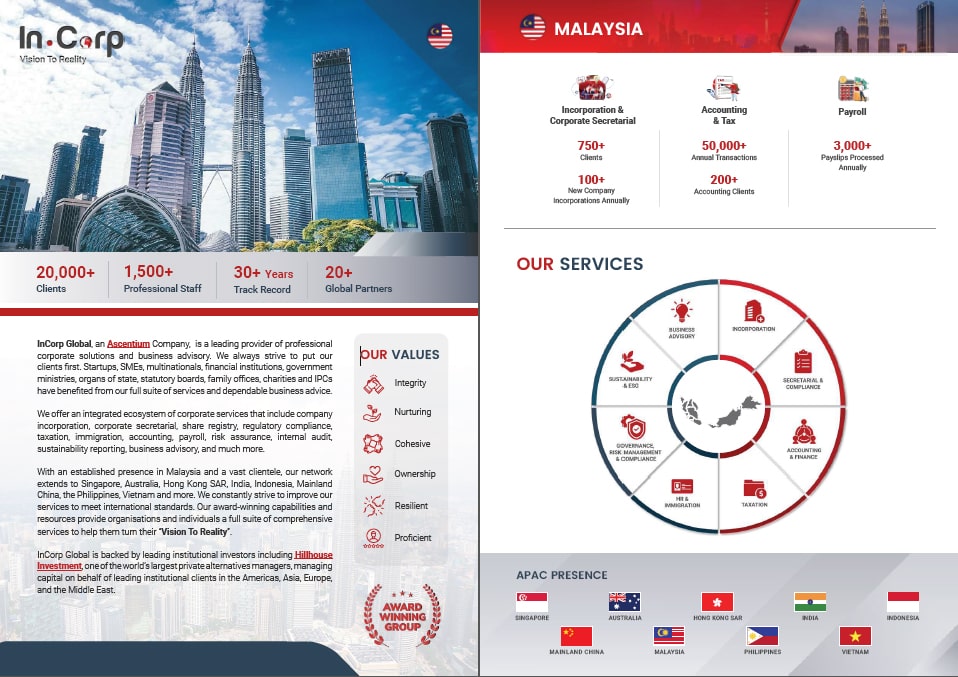
InCorp Malaysia helps foreign investors and CFOs establish and operate in Malaysia, covering company incorporation, corporate secretarial and compliance, tax advisory, accounting, immigration, EOR/PEO, GRC, ESG, and Labuan IBFC structuring, so you have one provider across the full market-entry lifecycle.
| Service | What it covers |
|---|---|
| Incorporation | Company registration with SSM for local and foreign-owned entities |
| Secretarial & Compliance | Statutory filings, company secretary appointment, ongoing compliance |
| Tax & Advisory | Corporate tax planning, filing, and cross-border structuring |
| Outsourcing (Accounting & Bookkeeping) | Bookkeeping, financial reporting, payroll |
| Immigration | Employment Pass and work visa applications for expatriate staff |
| EOR & PEO | Employer of Record and PEO services for hiring without a local entity |
| GRC | Governance, risk management, and regulatory compliance advisory |
| ESG | ESG strategy, reporting, and compliance |
| Labuan IBFC | Offshore company structuring under Labuan International Business and Financial Centre |
Why Do Foreign Investors Choose Malaysia for Business Expansion?

Malaysia is one of Southeast Asia’s fastest-growing, investor-centric, business-friendly, state-oriented, newly industrialised, mixed economies, making it an ideal location for doing business in Malaysia, with an average growth rate of just under 6 per cent over the last decade
Politically, it is a federation with 13 states and three federal territories of Kuala Lumpur, Putrajaya, and Labuan. The currency is Ringgit Malaysia (RM), and its four languages include Bahasa Malaysia (official language), English, Mandarin, and Tamil.
Important Sectors
Historically, Malaysia was a commodities-led economy where manufacturing and export of petroleum, palm oil, natural rubber, and timber dominated. But in recent years, services have contributed to the country’s economic growth and are now the largest sector of the economy.
The country has made huge strides in the IT sector, starting in the early 2000s. Foreign investors, entrepreneurs, and multinational companies have shown particular interest in investing in the insurance, finance, mining, manufacturing, and distribution sectors in the country.
Moreover, the country’s recent focus on R&D, design, innovation, logistics, advanced electronics manufacturing, biotechnology, photonics, and automation in the manufacturing sector has propelled Malaysia to be counted among one of the most dynamic corporate environments in South-east Asia.
Now with a new government in place, the country, which is strategically located in South East Asia (read Strait of Malacca, which is one of the busiest shipping lanes in the world), is fast becoming a prime destination in Asia for Malaysia company registration.
Easy to Do Business
Malaysia has consistently ranked among Southeast Asia’s most attractive investment destinations, supported by a stable regulatory environment, competitive corporate tax rates, and an extensive network of double taxation treaties.
Finance and Banking Sector
The financial and banking sector in Malaysia is also well-developed, with the Labuan International Business and Financial Centre another example, which offers an attractive offshore location for multinational companies dealing in financial services.
Along with the presence of several local financing options, including local and international financial institutions (commercial and investment banks), development finance, export credit, refinancing, private debt securities and venture capital, Malaysia has a strong Islamic banking sector and Islamic Capital Market, offering a range of Islamic banking products and services based on Shariah principles.
Special Economic Zones
In fact, industries in Malaysia are predominantly located in over 500 industrial estates and Free Zones developed throughout the country. These zones are categorised as export processing zones, which cater to the requirements of export-oriented industries. There are also specialised parks that have been developed to cater to the needs of specific industries.
Some examples of growth corridors in Malaysia include Iskandar Malaysia, Southern Johor, Northern Corridor Economic Region (NCER), East Coast Economic Region (ECER), Sabah Development Corridor, and Sarawak Corridor of Renewable Energy.
World-Class Infrastructure and Tax Exemptions
Malaysia’s other major advantages include relatively lower wage costs and a highly skilled, young, and productive local workforce. he country also boasts highly developed telecommunications, IT, and public infrastructure. Additionally, it has fully developed industrial parks, free economic or industrial zones with years of tax-free clauses, and technology parks.
The Multimedia Super Corridor programme has led to the development of cyber-centres and cyber-cities, and there are tax exemptions for ‘pioneer’ and ‘priority’ companies.
The country is well-served by digital and fibre optics technology, has eight international airports with air-cargo facilities, well-maintained super-express highways, and seven international seaports.
Robust IPR Regime and Liberal Foreign Exchange Controls
The country has liberal foreign exchange controls and a robust Intellectual Property Rights (IPR) regime. Moreover, the Government has initiated a “New Economic Model”, which identified eight Strategic Reform Initiatives (SRIs) to create an efficient, competitive, and business-friendly environment that attracts valued foreign investment.
The country has no restrictions on the repatriation of dividends, interest, capital, and profits.
Malaysia is also a signatory to several Investment Guarantee Agreements (IGAs), it has an avoidance of double taxation treaties with 68 other countries and regions, and it doesn’t levy any capital gains tax on investments or capital assets.
Many Have Already Done So
To put this in perspective, to date, over 5,000 foreign companies from more than 40 countries have established their operations in Malaysia in the last few years. Some have even diversified their operations in Malaysia, as a testimony to the Government’s efforts in making the country more attractive to foreign entrepreneurs and companies.
How Can InCorp Malaysia Help You Set Up and Operate in Malaysia?
So to take advantage of Asia’s growth story, Malaysia must also be on every foreign entrepreneur and company’s radar, as it is an ideal gateway for companies to the ASEAN region, which houses over 630 million people (almost double the population of the US.
And while doing so, you should be mindful of the distinctive regulatory and legal requirements – both pre-and post-incorporation- that Malaysia imposes. This is where we can help, as InCorp Malaysia is undoubtedly the leading corporate services provider in Singapore and South-east Asia, with over two decades of experience in providing such services as a group.
- When you engage us, our domain experts and a team of highly-qualified professionals advise you on the type of business entity most suited to your business.
- We also make sure that you are able to take advantage of all the tax incentive schemes prevalent in Malaysia, avoid penalties by fulfilling all filing requirements on your behalf, as well as avoid double taxation by taking advantage of the 60-plus cross-border taxation treaties the country has signed with other jurisdictions.
- With us, you will never have any surprises as we will let you know the cost of all our corporate services in advance, depending upon what you choose to engage us for.
-
Incorporation
For the registration of all businesses – including foreign companies – in Malaysia, the process of setting up a business entity is governed by the Registrar of Business, commonly known as the Suruhanjaya Syarikat Malaysia (SSM) or Companies Commission of Malaysia.
-
Compliance and Corporate Secretarial Services
Despite Malaysia becoming increasingly business-friendly over the last few years, the Registrar of Business in Malaysia is the Suruhanjaya Syarikat Malaysia (SSM) or Companies Commission of Malaysia, and the Inland Revenue Board of Malaysia (IRBM).
Outsourcing
Since all companies registered in Malaysia must keep proper books of accounts as stipulated by the country’s Companies Act 2016, engaging the leading company registration specialist of the region, InCorp Malaysia, is a good idea.
Tax
The standard rate of corporate taxation in Malaysia is 24% for a resident company.
Immigration
All expatriates who wish to work legally in Malaysia are required to obtain an employment pass first. To obtain this pass, you will need to find a Malaysian company that is willing to hire you and subsequently apply for the employment pass on your behalf.
EOR & PEO
Our Employer of Record (EOR) and Professional Employer Organisation (PEO) services are meticulously designed to take on the administrative weight of employment tasks and compliance requirements.
GRC
In today’s interconnected world, compliance with regulations and ethical practices is crucial to avoid fines, reputational damage, and legal issues. Stakeholders also expect businesses to uphold responsible governance. Our GRC services help companies navigate complex regulations, assess risks, and implement compliance strategies, ensuring strong corporate governance while supporting growth and profitability.
ESG
Our ESG services help businesses integrate ESG principles to stay competitive, attract investors, and drive long-term value. We identify ESG risks and opportunities, develop strategies, and ensure regulatory compliance. With a team of experienced professionals, we offer tailored solutions to align with your goals and enhance your brand reputation.
Labuan IBFC
Labuan International Business and Financial Centre offers a tax-efficient offshore structure for holding companies, trading entities, and financial services businesses operating across Asia. We handle Labuan company incorporation, licensing, and ongoing compliance for foreign investors seeking a strategic regional base.
FAQs for Corporate Services in Malaysia
What corporate services does InCorp Malaysia provide?
- InCorp Malaysia provides company incorporation, corporate secretarial and compliance, accounting and outsourcing, tax advisory, immigration and Employment Pass support, Employer of Record and PEO services, GRC, ESG advisory, and Labuan IBFC structuring, giving foreign investors a single provider across the full market-entry and operating lifecycle.
- In most sectors, yes, Malaysia permits full foreign ownership of a locally incorporated Sdn. Bhd. A limited number of restricted sectors carry equity conditions, so it's worth confirming your specific industry before structuring the entity.
- Yes. Under Section 196 of the Companies Act 2016, every private company (Sdn. Bhd.) must have at least one director who is ordinarily resident in Malaysia, meaning they hold a principal place of residence in the country. This applies regardless of the level of foreign ownership.
- Incorporation itself can be completed within a few working days once name approval and documentation are in order, though opening a corporate bank account and obtaining any sector-specific licences typically extends the full setup timeline.
- The standard corporate tax rate is 24% for resident companies, with preferential rates available for qualifying SMEs on the first portion of chargeable income.
- Yes. Section 235 of the Companies Act 2016 requires every company to appoint at least one company secretary, who must be a Malaysian citizen or permanent resident, within 30 days of incorporation.