
Malaysia’s Personal Data Protection Act 2010 (PDPA), also known as Act 709, is the country’s primary data privacy law. It governs how organisations collect, use, disclose, and store personal data in commercial transactions, and it binds any business, local or foreign, that processes the personal data of individuals in Malaysia. Following the Personal Data Protection (Amendment) Act 2024, which came into force in three phases across 2025, PDPA compliance now includes mandatory 72-hour breach notification, a compulsory Data Protection Officer (DPO), and fines of up to RM1 million.
The 2024 amendments have transformed the compliance landscape, introducing mandatory Data Protection Officer (DPO) appointments, enhanced breach notification requirements, and substantially increased penalties. For businesses operating in Malaysia, understanding these changes isn’t just about legal compliance, it’s about building sustainable competitive advantage through robust data governance.
This guide provides actionable strategies for implementing PDPA compliance effectively, helping you navigate the updated requirements whilst avoiding costly mistakes that have already impacted numerous Malaysian businesses.

What Changed in the PDPA Compliance Malaysia Legal Landscape?
1. Key Changes in PDPA 2024 Amendment
The Personal Data Protection (Amendment) Act 2024 is the most significant update to the Personal Data Protection Act Malaysia since it took effect in 2013, replacing “Data Users” with “Data Controllers” and introducing new legal obligations for “Data Processors” for the first time under Malaysia PDPA.
These changes align Malaysia more closely with international standards, particularly the EU’s GDPR framework. The amendment also introduces new definitions for biometric data and large-scale processing, creating clearer boundaries for compliance obligations.
Perhaps most significantly, the amendment establishes enhanced penalties, with maximum fines now reaching RM1 million and imprisonment terms of up to three years. This represents a five-fold increase from previous penalty structures, demonstrating the government’s commitment to robust data protection enforcement.
2. Implementation Timeline and Deadlines
The PDPA 2024 amendment follows a carefully structured three-phase implementation:
Phase 1 (1 January 2025):
Phase 1 of PDPA Malaysia (1 January 2025) covered administrative changes only corrections to the Malay-language text of the Act, provisions for electronic service of notices, and other non-substantive amendments.
What this means for you: While these updates may seem technical, they mark the official start of the compliance countdown. Businesses should treat January as the baseline for reviewing data protection policies and preparing for more impactful changes to come.
Phase 2 (1 April 2025):
Phase 2 of PDPA compliance in Malaysia (1 April 2025) introduced substantive obligations for data processors, cross-border transfers, and sensitive data handling:
-
Data processors made directly accountable: Processors are now legally bound to adopt technical and organisational measures to protect personal data, not just follow controller instructions.
-
Revised definitions: Biometric data is classified as sensitive personal data, and personal data of deceased persons is excluded.
-
Cross-border data transfers: A new regime replaces the outdated “whitelist” system, requiring businesses to justify overseas transfers under broader legal bases. The Commissioner’s Guidelines on Cross-Border Personal Data Transfer (issued 29 April 2025) confirm that transfers are now permitted where the destination country has a substantially similar law or an adequate level of protection, replacing the old Ministerial whitelist entirely..
-
Stricter penalties: Non-compliance with core principles can now result in heavier fines and enforcement actions.
What this means for you: Companies must update contracts with third-party processors, reassess vendor risks, and review how they manage sensitive or cross-border data.
Phase 3 (1 June 2025):
The final phase introduces the most business-critical changes:
-
Mandatory Data Protection Officer (DPO): Controllers and processors must appoint at least one DPO. Current guidelines suggest the requirement will apply to organisations with large-scale data processing activities, especially involving sensitive data.
-
Mandatory breach notifications: Organisations must notify the Commissioner promptly in the event of a personal data breach, and inform affected individuals if harm is likely. While the law states “as soon as practicable,” industry practice and global benchmarks point to a 72-hour notification window as the expected compliance standard.
-
Right to data portability: Data subjects can request their data in a structured, commonly used format, creating new operational requirements for IT and compliance teams.
What this means for you: Businesses should already be preparing breach response playbooks, clarifying internal reporting channels, and identifying suitable candidates for the DPO role.
What Are the Mandatory Post 2024 PDPA Compliance Requirements in Malaysia?
1. Data Protection Officer (DPO) Appointment Requirements
The mandatory DPO appointment represents one of the most significant changes in Malaysia PDPA compliance. Beginning 1 June 2025, all data controllers and processors conducting large-scale processing must appoint qualified DPOs and register them with the Personal Data Protection Commissioner.
Large-scale processing criteria include:
- 20,000 or more data subjects for general personal data
- 10,000 or more data subjects for sensitive personal data (including financial data)
- Conducting systematic monitoring of data subjects
- Operating across multiple jurisdictions within Malaysia
DPO qualification requirements include relevant professional qualifications, demonstrated data protection expertise, and independence from core business operations. The DPO must report directly to senior management and maintain professional development through continuous training.
The Commissioner’s Guideline also sets residency and language requirements that are frequently overlooked. The appointed DPO must either be physically present in Malaysia for at least 180 days in a calendar year, or be easily contactable in Malaysia by other means, and must be proficient in both Bahasa Malaysia and English. A DPO may be an existing employee or an outsourced appointee, and a single DPO may serve multiple entities provided they remain readily accessible to each one.
Implementation checklist for DPO appointment:
- Develop comprehensive job descriptions incorporating regulatory requirements
- Establish reporting structures ensuring organisational independence
- Create training programmes covering Malaysian data protection law
- Implement registration procedures with the Personal Data Protection Commissioner
- Establish ongoing professional development frameworks
2. Data Breach Notification Obligations
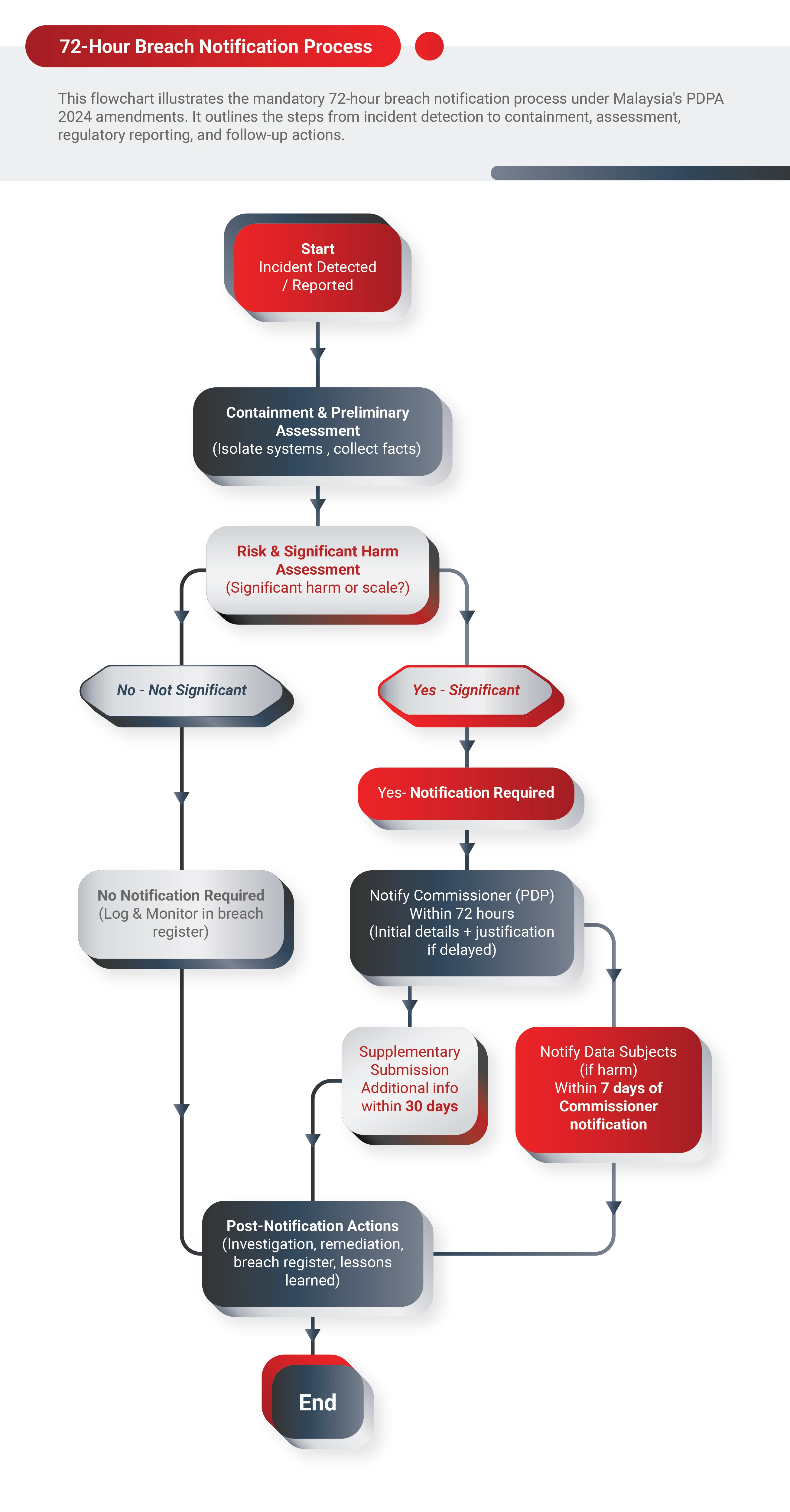
Under PDPA rules, organisations must notify the Personal Data Protection Commissioner within 72 hours of becoming aware of a qualifying data breach, one of the strictest reporting timelines introduced by the 2024 amendments to Malaysia PDPA.
Qualifying breaches include unauthorised access, accidental disclosure, data theft, or system compromises affecting personal data security. The assessment criteria consider the likelihood of harm to data subjects, the volume of affected data, and the sensitivity of information involved.
Breach notification requirements encompass:
- Initial notification to the Commissioner within 72 hours
- Data subject notification when high risk to rights and freedoms exists
- Comprehensive breach documentation including timeline, impact assessment, and remedial actions
- Follow-up reports detailing investigation outcomes and preventive measures
Organisations must establish 24/7 incident response capabilities to meet these stringent timelines. This requires dedicated response teams, clear escalation procedures, and pre-approved notification templates.
How Do You Implement PDPA Compliance in Malaysia? (Step-by-Step)
Phase 1: Compliance Assessment and Gap Analysis
-
Data Mapping and Inventory Process
Effective PDPA compliance in Malaysia starts with a full data-mapping exercise: identifying every category of personal data your organisation holds, tracing how it flows between systems, and documenting each processing activity.
Data mapping methodology:
- System inventory: Catalogue all systems, applications, and databases containing personal data
- Data flow analysis: Map how personal data moves between systems, departments, and third parties
- Purpose documentation: Record the specific business purposes for each data processing activity
- Legal basis identification: Determine the lawful basis for each processing activity under PDPA principles
The data inventory should capture data categories, sources, storage locations, retention periods, and access controls. This foundation enables informed decision-making about compliance priorities and resource allocation.
Third-party processor identification requires examining all vendor relationships, service agreements, and data sharing arrangements. Each relationship must be evaluated against the new data processor obligations taking effect in April 2025.
-
Legal Basis Review and Documentation
The 2024 amendments require enhanced documentation of legal bases for data processing. Organisations must review existing consent mechanisms and ensure they meet updated standards for granular, specific, and withdrawable consent.
Consent mechanism updates must address:
- Granular consent options allowing data subjects to consent to specific processing purposes
- Clear withdrawal mechanisms enabling easy consent revocation
- Record-keeping systems documenting consent capture, changes, and withdrawals
- Regular consent renewal for ongoing processing activities
Legitimate interest assessments provide alternative legal bases for processing where consent may be impractical. These assessments must balance organisational interests against data subject rights and freedoms.
Phase 2: Policy and Procedure Development
-
Privacy Notice Updates and Requirements
Updated privacy notices must comply with enhanced disclosure requirements under the 2024 amendments. These notices serve as primary communication tools between organisations and data subjects, explaining processing activities and individual rights.
Mandatory disclosure requirements include:
- Specific processing purposes with clear, plain language descriptions
- Data retention periods or criteria for determining retention
- Third-party sharing details including categories of recipients and transfer safeguards
- Data subject rights with clear instructions for exercising these rights
- Contact information for privacy enquiries and complaints
Privacy notice frameworks should accommodate different contexts, including website visitors, customers, employees, and business partners. Each framework must reflect the specific data processing activities and legal bases relevant to that relationship.
-
Consent Management System Implementation
Robust consent management systems enable organisations to capture, track, and manage data subject consent effectively. These systems must integrate with existing business processes whilst providing audit trails for regulatory compliance.
Implementation requirements include:
- Consent capture mechanisms integrated into customer touchpoints
- Preference management allowing granular consent control
- Automated withdrawal processing enabling immediate consent revocation
- Audit logging documenting all consent-related activities
- Regular consent review identifying expired or withdrawn consents
Record-keeping requirements mandate comprehensive documentation of consent decisions, including timestamps, consent versions, and any subsequent changes or withdrawals.
Phase 3: Technical and Organisational Measures
-
Data Security Implementation
The Security Principle under PDPA requires appropriate technical and organisational measures to protect personal data. The 2024 amendments emphasise risk-based approaches, requiring security measures proportionate to processing risks.
Technical safeguards implementation encompasses:
- Encryption standards for data at rest and in transit
- Access control mechanisms implementing least-privilege principles
- Network security measures including firewalls and intrusion detection
- Backup and recovery systems ensuring data availability and integrity
- Regular security assessments identifying and addressing vulnerabilities
Organisational measures complement technical controls through policy frameworks, staff training, and governance structures. These measures ensure sustained security practices across all business operations.
-
Data Subject Rights Management
Efficient data subject rights management requires systematic processes for handling access requests, corrections, and complaints. The PDPA mandates 21-day response timeframes for access requests, requiring streamlined handling procedures.
Request handling procedures must include:
- Identity verification processes ensuring requests come from legitimate data subjects
- Request categorisation distinguishing between access, correction, and complaint requests
- Search and retrieval systems locating relevant personal data across organisational systems
- Response preparation ensuring complete and accurate information provision
- Quality assurance reviews before response dispatch
Template forms standardise request handling whilst ensuring consistent compliance with regulatory requirements. These templates should accommodate different request types and complexity levels.
What Are The Industry-Specific PDPA Compliance Guidelines in Malaysia?
1. Healthcare Sector Compliance Requirements
Healthcare organisations face unique PDPA compliance challenges due to the sensitive nature of patient data and complex regulatory intersections. Patient data processing must balance treatment needs with privacy protection, requiring nuanced approaches to consent and disclosure.
Medical record retention periods must align with both PDPA requirements and healthcare-specific regulations. The Retention Principle requires disposal when data is no longer necessary, but medical records often require extended retention for patient safety and legal reasons.
Third-party service agreements with medical equipment providers, laboratories, and administrative services must address data processor obligations. These agreements require careful attention to cross-border transfers and adequacy assessments.
2. Financial Services Data Protection
Financial institutions must navigate complex interactions between PDPA compliance and prudential regulations. Customer due diligence requirements often necessitate extensive personal data collection, requiring careful legal basis documentation and consent management.
Credit scoring and profiling activities require particular attention to data subject rights, especially access and correction rights. Financial institutions must balance legitimate business interests with individual privacy rights.
Anti-money laundering data sharing obligations may conflict with PDPA disclosure restrictions, requiring careful legal analysis and appropriate safeguards for regulatory sharing.
3. E-commerce and Digital Platform Compliance
E-commerce platforms face unique challenges with customer profiling and marketing automation. Consent management becomes particularly complex with multiple processing purposes and extensive third-party integrations.
Payment data processing requires enhanced security measures and careful attention to cross-border transfers. International payment processors must demonstrate adequate protection levels or implement appropriate safeguards.
What Are the Most Common PDPA Compliance Mistakes in Malaysia?
Top 5 Implementation Pitfalls
1. Inadequate Consent Mechanisms
Many organisations continue using pre-ticked boxes or bundled consent approaches that violate updated consent requirements. The solution involves implementing granular consent processes that allow specific purpose selection and easy withdrawal.
Cost of non-compliance: Penalties up to RM500,000 plus reputational damage from privacy violations.
2. Poor Data Processor Management
Organisations frequently lack comprehensive written agreements with data processors, creating compliance gaps and shared liability risks. The solution requires standardised data processing agreements incorporating all mandatory clauses.
3. Insufficient Breach Response Planning
Many organisations lack formal breach response procedures, creating risks of missing the 72-hour notification deadline. Effective solutions involve establishing 24/7 incident response teams with clear escalation procedures.
Penalties: Up to RM1 million for non-reporting of qualifying breaches.
4. Inadequate Staff Training
Organisations often treat PDPA compliance as purely an IT responsibility, neglecting company-wide privacy awareness. Comprehensive solutions require multi-level training programmes covering legal requirements, practical procedures, and incident response.
5. Cross-Border Transfer Violations
Many organisations transfer personal data internationally without proper adequacy assessments or standard contractual clauses. Solutions involve comprehensive transfer impact assessments and appropriate safeguards.
Red Flags During Implementation
Organisations should monitor for warning signs that may indicate compliance difficulties:
- Delayed DPO appointments approaching the June 2025 deadline
- Incomplete data mapping exercises that fail to identify all processing activities
- Lack of senior management buy-in limiting resource allocation and strategic commitment
- Insufficient budget allocation for necessary system upgrades and training programmes
Early identification of these red flags enables corrective action before compliance deadlines.

PDPA Compliance Cost-Benefit Analysis
1. Investment Requirements
Implementing comprehensive PDPA compliance requires significant financial investment across multiple areas:
DPO appointment costs: RM80,000-150,000 annually, depending on qualification levels and organisational size.
System upgrades and security measures: RM50,000-200,000 for technical implementations, including consent management systems, security enhancements, and audit capabilities.
Training and awareness programmes: RM20,000-50,000 for comprehensive staff education covering legal requirements, procedures, and incident response.
Legal and consulting fees: RM30,000-100,000 for compliance assessments, policy development, and ongoing legal advice.
2. Non-Compliance Risks
The 2024 amendments substantially increase penalties for PDPA violations:
Updated penalties: Up to RM1 million or three years imprisonment for serious violations, representing a five-fold increase from previous levels.
Reputational damage costs often exceed direct penalties, particularly for consumer-facing businesses where privacy breaches erode customer trust.
Business disruption from regulatory investigations can halt operations and require extensive management attention.
3. Compliance Benefits
Effective PDPA compliance in Malaysia generates measurable business benefits:
Enhanced customer trust leads to improved customer retention and competitive advantage in privacy-conscious markets.
Improved data governance creates operational efficiencies through better data management and reduced redundancy.
Reduced breach risks minimise potential financial losses and reputational damage from data incidents.
What is The PDPA Compliance Implementation Timeline And Action Steps?
1. Immediate Actions (October 2025)
Organisations must begin immediate preparation for upcoming compliance deadlines:
- Conduct comprehensive data audits identifying all personal data processing activities
- Initiate DPO recruitment processes to meet June 2025 appointment deadlines
- Review and update privacy notices incorporating new disclosure requirements
- Establish breach response procedures preparing for 72-hour notification requirements
2. Short-term Goals (November-December 2025)
Focus on foundational implementation elements:
- Complete staff training programmes ensuring company-wide privacy awareness
- Implement technical security measures addressing identified vulnerabilities
- Finalise data processing agreements with all third-party processors
- Test incident response procedures ensuring effective breach management capabilities
3. Long-term Compliance Management (2026 and beyond)
Sustain compliance through ongoing management activities:
- Regular compliance audits assessing adherence to PDPA requirements
- Continuous staff training updates reflecting regulatory changes and best practices
- Monitor regulatory developments ensuring awareness of future amendments
- Annual privacy impact assessments evaluating processing risks and controls
What Are The PDPA Practical Tools and Resources in Malaysia?
1. Compliance Checklists
DPO Appointment Checklist:
- Define qualification requirements and reporting structures
- Establish registration procedures with regulatory authorities
- Create ongoing training and development programmes
- Implement independence safeguards and conflict management
Data Breach Notification Checklist:
- Establish incident detection and assessment procedures
- Create 72-hour notification templates and processes
- Develop data subject communication protocols
- Implement documentation and follow-up requirements
Privacy Notice Compliance Checklist:
- Include all mandatory disclosure elements
- Ensure plain language and accessibility
- Implement regular review and update procedures
- Create version control and change documentation
2. Template Documents
Comprehensive template libraries support efficient implementation:
- Data processing agreement templates covering all mandatory clauses
- Privacy impact assessment templates for systematic risk evaluation
- Data subject request forms streamlining rights management
- Breach notification templates ensuring complete regulatory reporting
3. Monitoring and Audit Tools
Effective compliance requires ongoing monitoring capabilities:
- Compliance dashboard metrics providing real-time compliance visibility
- Regular assessment schedules ensuring systematic compliance reviews
- Key performance indicators measuring privacy programme effectiveness
Your Next Steps: Building Sustainable PDPA Compliance
The 2024 PDPA amendments represent both challenge and opportunity for Malaysian businesses. Organisations that approach implementation strategically will not only avoid substantial penalties but also gain competitive advantages through enhanced data governance and customer trust.
Key implementation priorities focus on immediate deadline preparation: DPO recruitment, breach response capabilities, and policy updates. Success requires cross-functional coordination between legal, IT, and business operations teams.
Proactive compliance approaches reduce both implementation costs and operational risks. Early preparation enables thoughtful system design and staff training, avoiding rushed implementations that may create compliance gaps.
The evolving privacy landscape demands ongoing attention and strategic planning. Organisations that embed privacy-by-design principles into their operations will be best positioned for future regulatory developments and market opportunities.
Don’t let PDPA compliance become a source of business risk. Contact our compliance experts today for a personalised consultation and comprehensive gap analysis. Our team will help you navigate the complex requirements and build sustainable compliance frameworks that protect your business whilst enabling growth.
FAQs on PDPA Compliance Malaysia
- The 2024 amendments introduce significantly higher penalties for non-compliance. Fines can now reach up to RM1,000,000, and severe breaches may also result in imprisonment. These changes underscore the importance of robust data protection frameworks for all businesses.
- The Personal Data Protection Act (PDPA) applies to any entity that processes personal data in connection with commercial transactions within Malaysia. This includes private companies, service providers, and other organisations. The Act does not apply to the Federal and State Governments.
- Following the 2024 amendments, organisations are now required to notify the Personal Data Protection Commissioner of a data breach. If the breach meets specific criteria, affected individuals must also be informed within a designated timeframe to allow them to take protective measures.
- Personal data is defined as any information that can directly or indirectly identify an individual. This includes a wide range of information such as names, contact details, financial records, email addresses, and biometric data.
- General, Notice and Choice, Disclosure, Security, Retention, Data Integrity, and Access. Together they govern how personal data must be collected, secured, used, and made accessible to the individual it belongs to.
Ensure Your Business is PDPA Compliant
About the Author