
InCorp Malaysia is the leading corporate services provider, expertly handling company secretarial and SSM filings for foreign-owned Sdn Bhd companies in Malaysia, delivering comprehensive, end-to-end support. We consolidate essential services under one roof, navigating complex regulations to significantly reduce compliance risk and streamline operations. This allows foreign businesses to focus entirely on growth and expansion in Malaysia.
Defining a Sdn Bhd Company in Malaysia
An Sdn Bhd (Sendirian Berhad) is a private limited company in Malaysia that operates as a separate legal entity, providing limited liability protection to its shareholders.
It is registered with the Companies Commission of Malaysia and governed under the Companies Act 2016 Malaysia. This structure allows the company to own assets, enter into contracts, and operate independently from its owners.
As the most widely adopted business structure in Malaysia, it is commonly used by SMEs, growing enterprises, and foreign investors establishing a local presence.
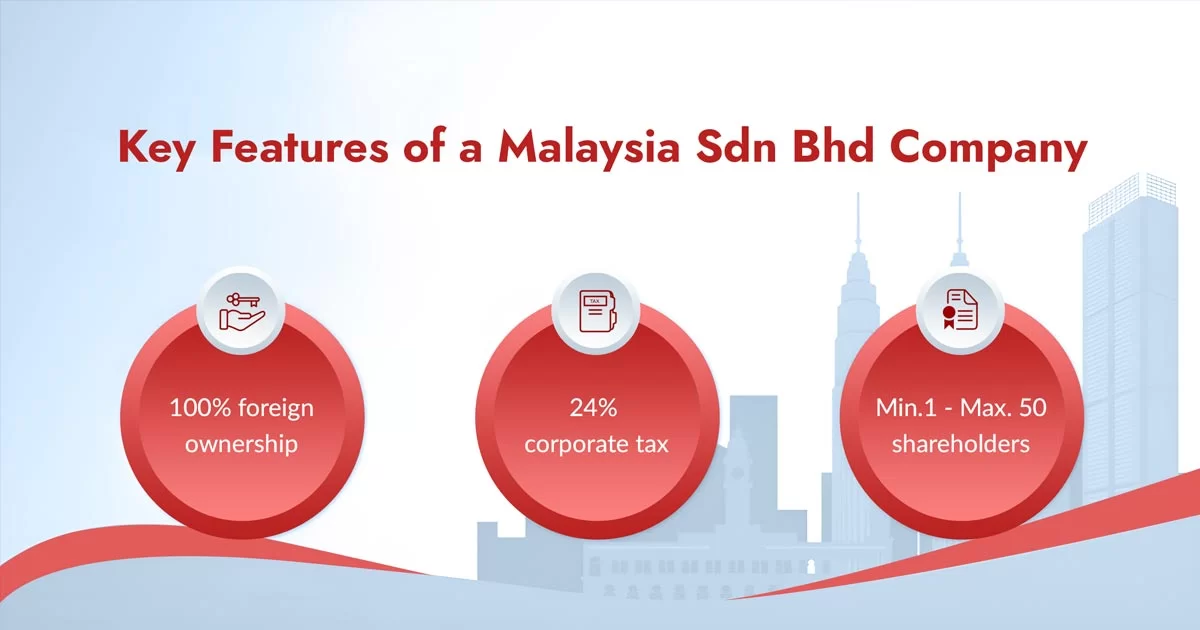
A Sendirian Berhad (Sdn Bhd) company is a private limited company that both locals and foreigners in Malaysia can start. With the World Bank ranking Malaysia as the 12th easiest and friendliest place to do business, Sdn Bhd companies are becoming popular business entities.
Choosing the right company structure is crucial to taking advantage of Malaysia’s numerous business opportunities. Embarking on your Malaysia company registration as an Sdn Bhd will undoubtedly allow your company to expand and flourish.
What Are the Key Characteristics of a Sdn Bhd?
1. Limited Liability Protection for Shareholders
- The idea of a limited liability company protects the shareholders/ owners’ personal wealth.
- The company’s shareholders are only liable for debts accrued by the company in accordance with their levels of investment and not more.
- The Companies Commission of Malaysia (SSM) administers all Sdn Bhd registrations and ongoing compliance obligations. You can verify a company’s registration status via the SSM e-Info portal.
2. Separate Legal Entity Status & Perpetual Succession
- A Sdn Bhd company is a separate legal entity from its shareholders/owners.
- Its status as a separate legal entity allows it to operate regardless of the identities of its founders, directors, and shareholders.
- Any deaths or retirements of its founders, directors, and shareholders will have no effect, as the company will continue to exist and operate unless it is dissolved.
- A Sdn Bhd company can acquire assets, enter into contracts, and sue or be sued.
3. Transferability of Ownership in Sdn Bhd
- A shareholder of an Sdn Bhd in Malaysia can sell or transfer shares to any person of the shareholder’s choice as long as the potential buyer can afford the shares.
4. Ease of Fundraising for Sdn Bhd Companies
- It is relatively simple for an Sdn Bhd company to raise money either by equity or loan.
- The share concept of Sdn Bhd makes it easy for investors to invest in the company, as long as they can agree on the valuation.
- Sdn Bhd is a well-recognised corporate structure, so it is easier to borrow money from banks at lower rates than rates paid by other business structures. Banks may view loans for Sdn Bhd companies as less risky than loans for other business structures.
5. Flexibility in Profit Distribution
- The shareholder/owner of an Sdn Bhd company benefits from the advantage of being able to distribute the company’s profit as deemed suitable.
- Company owners determine the salaries, directors’ fees, bonuses, dividends, and other benefits. They also dictate how much money is to be reinvested into the business.
Sdn Bhd vs Other Business Structures in Malaysia
Choosing the right structure depends on your business goals, risk exposure, and growth plans.
1. Sdn Bhd vs Sole Proprietorship
A Sdn Bhd offers limited liability, meaning your personal assets are generally protected. In contrast, a sole proprietorship exposes the owner to full personal liability.
In practice:
- Choose a Sdn Bhd if you plan to scale, hire employees, or work with corporate clients
- Choose a sole proprietorship if you are running a small, low-risk business with minimal expansion plans
2. Sdn Bhd vs Limited Liability Partnership (LLP)
A Sdn Bhd operates as a corporate entity with shareholders and directors, while an LLP combines partnership flexibility with limited liability.
In practice:
- A Sdn Bhd is typically preferred for commercial businesses and expansion
- An LLP is more suitable for professional services or partnerships with simpler operational structures
3. Sdn Bhd vs Berhad (Bhd)
An Sdn Bhd is a private limited company limited to 50 shareholders, and its shares cannot be offered to the public or traded on the stock exchange. A Berhad (Bhd) is a public limited company with no shareholder limit that can raise capital from the public and list on Bursa Malaysia. In practice, a Sdn Bhd suits SMEs and privately held businesses, while a Berhad suits larger companies seeking public funding.
4. Sdn Bhd vs Labuan Company
A Sdn Bhd and a Labuan company are designed for different commercial and regulatory purposes. A Sdn Bhd is typically used for businesses operating within Malaysia, while a Labuan company is commonly structured for international trading, investment holding, and cross-border activities through the Labuan International Business and Financial Centre (Labuan IBFC). The appropriate structure depends on the company’s operational footprint, tax considerations, licensing requirements, and regional expansion strategy.
What Are the Roles of People in a Sdn Bhd Company?
1. Shareholders: Ownership & Decision-Making
-
- They are the investors and owners of the Sdn Bhd company
- They may not run the day-to-day operations of the company and will delegate such responsibility to directors
- They may call for a meeting to discuss and decide on important issues, such as appointing and removing directors and an auditor
- They are only liable for capital invested in the Sdn Bhd and not more
2. Directors: Management & Compliance Responsibilities
- They are the officers appointed by the shareholders to manage the company
- They have a statutory obligation to ensure the company follows the Companies Act 2016 and the Corporate Tax regulations
- More often than not, most small to medium-sized (SME) Sdn Bhd may have the same individual as shareholders and directors
3. Company Secretary: Legal Compliance & Governance
- As required by the Companies Act 2016, all Sdn Bhd companies must have a Malaysian company secretary
- Their roles are to advise directors on issues pertaining to the Companies Act 2016 and ensure the company complies with it
What Are the Advantages of a Sdn Bhd in Malaysia?
- Foreigners can be shareholders and can fully own the Sdn Bhd
- Foreigners can be a director as long as they have a local residential address
- A single shareholder company/single person company (“SPC”) is possible
- Malaysia Sdn Bhd corporate tax is tiered: 15% on the first RM150,000, 17% on the next RM450,000, and 24% above RM600,000. From YA 2024, SME rates don’t apply where over 20% is foreign-owned.
- There are more tax incentives (e.g. pioneer status, investment tax allowance) given to Sdn Bhd companies as compared to other corporate structures
- A company can act as a holding company to own real assets such as properties etc. This allows property investors to have a corporate structure to better manage their property portfolio
- Sdn Bhd can have up to 50 shareholders, which is sufficient for small to medium-sized businesses. Berhad would be an alternative company structure if there are more than 50 investors
Who Should Consider a Sdn Bhd Company?
While an Sdn Bhd is the most common structure in Malaysia, it becomes particularly relevant once a business moves beyond the early stage.
A Sdn Bhd is typically suitable if you:
- Plan to scale beyond a small, owner-managed operation
- Intend to hire employees or build a team
- Require credibility when working with corporate clients, banks, or investors
- Are you entering Malaysia as a foreign-owned business
- Need a structure that supports long-term expansion, funding, or regional growth
Malaysia’s strong business environment is reflected in its consistent placement in the World Bank’s Doing Business rankings and MIDA’s investment promotion framework.
In practice, businesses that expect to grow, take on risk, or operate beyond a simple setup tend to benefit more from an Sdn Bhd structure.
For smaller or early-stage businesses, a simpler structure may be sufficient initially. However, many companies transition to an Sdn Bhd as operations expand, and compliance, liability, and credibility become more important.
For businesses planning long-term operations in Malaysia, an Sdn Bhd structure is generally the more scalable and sustainable option.
Not sure if an Sdn Bhd is the right structure for your business? A quick discussion can help you evaluate your options before committing.
How Do I Register a Sdn Bhd Company in Malaysia?
To register a Sdn Bhd company in Malaysia, you submit your application online to the Companies Commission of Malaysia (SSM) through the MyCoID portal. Most companies are incorporated within one to three working days, once the proposed name is approved and all documents are in order.
The process follows five clear steps:
- Reserve your company name. Log in to the SSM MyCoID portal, submit your proposed name for a name availability check, and pay the RM50 reservation fee. An approved name is held for 30 days.
- Prepare your details. Gather identification for every director and shareholder (MyKad for locals, passport for foreigners), their residential addresses, and your business activity (MSIC) code. A company constitution is optional but recommended.
- Submit the incorporation application. Complete the online forms within the 30-day name approval window and pay the SSM incorporation fee of RM1,000.
- Receive your Notice of Registration. SSM usually approves within one to three working days, and the notice serves as your official proof of incorporation.
- Complete the tasks after incorporation. Appoint a licensed company secretary within 30 days, open a corporate bank account, and register for corporate tax with the Inland Revenue Board of Malaysia (LHDN).
What Are the Minimum Requirements for Sdn Bhd Incorporation?
The minimum requirements to incorporate a Sdn Bhd company in Malaysia are one resident director, one shareholder, a registered local address, and a minimum paid-up capital of RM1. In full, you will need:
- At least one director aged 18 or above who ordinarily resides in Malaysia
- At least one shareholder, either an individual or a corporate entity, up to a maximum of 50
- A registered office address in Malaysia where statutory records are kept
- A minimum paid-up capital of RM1, though banking or licensing needs often call for a higher amount
- A licensed company secretary appointed within 30 days of incorporation
- A unique proposed company name and up to three MSIC codes describing your business activity
How Much Does It Cost to Register a Sdn Bhd in Malaysia?
It costs RM1,010 in official government fees to register a Sdn Bhd in Malaysia. This is paid to SSM and covers the RM1,000 incorporation fee plus a RM10 processing fee. Reserving your company name costs another RM50.
Most businesses pay more than this, because the law requires every Sdn Bhd to appoint a licensed company secretary within 30 days. Your total depends on how you register:
- Self-filing through the MyCoID portal: around RM1,060, but you still need to appoint a secretary separately
- Digital service provider: around RM1,500 to RM2,000, usually including your first year of secretarial support
- Corporate secretarial firm: around RM2,500 to RM4,000, including document preparation and advisory support
You should also budget for first year running costs, even if the company has not started trading. Expect a company secretary retainer of RM600 to RM2,000 a year, a registered office address of RM300 to RM1,200 a year, and annual audit and accounting fees of RM2,000 to RM5,000 a year.
What Are the Ongoing Compliance Requirements for a Sdn Bhd?
Once incorporated, a Sdn Bhd must meet annual statutory obligations to remain in good standing:
- File an Annual Return with SSM each year
- Hold an Annual General Meeting and keep updated statutory records
- Appoint an auditor and submit audited financial statements
- File the corporate tax return with LHDN within seven months of the financial year end
- Notify SSM of any change in directors, shareholders, or company details within the required timeframe
A Sdn Bhd must also comply with Malaysia’s e-invoicing mandate. Under LHDN, businesses with annual turnover above RM1 million issue validated e-invoices through the MyInvois system, with Phase 4 (RM1 million to RM5 million) effective from 1 January 2026 and a relaxation period to 31 December 2027. Businesses below RM1 million in turnover are currently exempt.
What Are the Disadvantages of a Sdn Bhd in Malaysia?
- There are more statutory compliance requirements for Sdn Bhd companies as compared to other corporate structures, such as yearly statutory audits and the appointment of a Malaysian company secretary.
- Compliance costs could be higher as the Company needs to incur the company secretary’s retainer fee (approximately RM2,000 a year) and audit fee (approximately RM1,000 to RM8,000 depending on revenue).
Overall, a Sdn Bhd company would be considered the best corporate structure in Malaysia that’s suitable for any type of entrepreneurs, be it foreigners, start-ups or established businessmen.
Making the Right Decision Before You Incorporate
Setting up an Sdn Bhd is straightforward. Structuring it correctly is where most businesses see long-term impact. Before proceeding, it is important to consider ownership structure, compliance requirements, and how your Malaysian entity fits into your broader business strategy.
If you’re unsure whether an Sdn Bhd is the right structure for your business, a brief discussion can clarify the most suitable approach for your objectives. Whether you’re establishing a foothold or scaling operations, InCorp Global Malaysia offers the specialised expertise you need to succeed in Malaysia and the Labuan region.
FAQs About Sdn Bhd Company in Malaysia
- In Malaysia, all Sdn Bhd companies, including those 100% foreign-owned, are legally required to appoint a qualified company secretary. This secretary is responsible for ensuring compliance with the Companies Act 2016 and managing all statutory filings with the Companies Commission of Malaysia (SSM). Professional firms like incorp specialize in providing these essential services, helping businesses navigate complex regulatory requirements.
- Key duties include maintaining statutory registers, preparing and filing annual returns, updating company records with SSM, and advising the board on compliance matters. A professional company secretary also ensures that board meetings and general meetings are properly convened and documented, safeguarding the company's legal standing. incorp ensures all these obligations are met efficiently, allowing foreign investors to focus on their core business operations.
- InCorp Malaysia provides comprehensive company secretarial services, acting as the appointed secretary for foreign-owned Sdn Bhd companies. Our experts manage all SSM filings, corporate governance, and regulatory compliance, leveraging over 20 years of experience in the Malaysian market. This ensures your company adheres to all local laws, minimising risks and potential penalties.
- Non-compliance can lead to severe penalties, including fines, imprisonment for directors, and even the striking off of the company from the SSM register. For instance, failure to file annual returns can result in fines up to RM50,000 for the company and its directors. Engaging a reliable partner like incorp helps mitigate these risks by ensuring timely and accurate submissions.
- No, a foreigner cannot directly act as a company secretary for their Sdn Bhd in Malaysia unless they are a resident in Malaysia and are a member of a professional body prescribed by the Minister of Domestic Trade and Consumer Affairs. The Companies Act 2016 mandates that a company secretary must be a natural person, ordinarily resident in Malaysia, and a member of a professional body approved by the Minister. Therefore, foreign-owned companies typically appoint a professional firm like InCorp Malaysia to fulfil this statutory requirement.
- Annual returns must be filed with SSM within 30 days from the anniversary of the company's incorporation date, while financial statements must be lodged within 30 days from the circulation date to members. For example, if your company was incorporated on January 15, 2026, the annual return would be due by February 14, 2027. incorp proactively manages these deadlines, ensuring all filings are submitted well in advance to avoid late penalties.
Ready to Set Up Your Sdn Bhd Company in Malaysia?
About the Author