If your business operates (or plans to operate) in Southeast Asia, the Johor-Singapore Special Economic Zone (JS-SEZ) demands your attention. This bilateral initiative, formalised in January 2025, creates a single economic corridor spanning 3,571 km² across nine flagship zones in southern Malaysia. That’s nearly five times the size of Singapore, positioned directly on the border between two of ASEAN’s most dynamic economies.
Singapore-based firms have already committed more than S$5.5 billion (approximately RM19 billion) since the agreement was signed. Johor recorded RM27.4 billion in foreign direct investment in Q1 2025 alone – a RM24 billion increase compared to the same period in 2024. For companies seeking to capitalise on supply chain diversification, reduced operating costs, or access to Singapore’s financial infrastructure without Singapore’s price tag, the JS-SEZ offers a compelling proposition.
This article breaks down what ASEAN businesses need to know: available tax incentives, infrastructure coming online, prioritised sectors, and practical steps for market entry. Whether you’re considering expansion from Singapore into Johor, evaluating the manufacturing zone, or exploring the data centre boom reshaping the region, the following sections provide the specifics you need to make informed decisions.
Johor-Singapore SEZ: A Single Corridor, Two Sets of Advantages
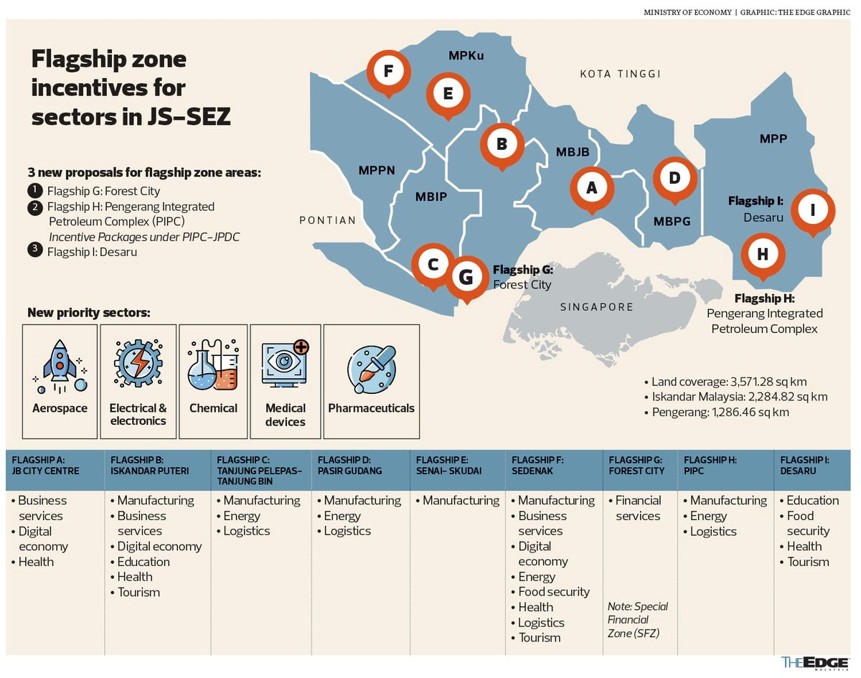
The JS-SEZ comprises nine flagship zones, each with a distinct industrial focus. Johor Bahru City Centre and Iskandar Puteri anchor business services and digital economy activities. Tanjung Pelepas and Pasir Gudang handle logistics and port operations. Forest City operates as a special financial zone, while Pengerang hosts the integrated petroleum complex.
The remaining zones (Senai-Skudai, Sedenak, and Desaru) round out the offering with manufacturing, technology parks, and tourism development. Across all nine zones, 11 priority sectors receive targeted support: manufacturing, logistics, financial services, digital economy, tourism, food security, health, energy, green economy, business services, and education.
What makes this arrangement work? Singapore delivers world-class financial infrastructure and global connectivity, but at a premium that squeezes margins. Johor offers lower operating costs, extensive land, and competitive utility rates. The JS-SEZ lets businesses combine both: a treasury function or regional headquarters in Singapore paired with manufacturing, warehousing, or back-office operations, just 15 minutes across the border.
The economic foundations supporting this model are already in place. Malaysia ranked as Singapore’s third-largest trading partner in 2023, with bilateral trade hitting S$123.6 billion. Singapore was Malaysia’s largest FDI source that same year, contributing RM43.7 billion – nearly a quarter of Malaysia’s total foreign investment. The Johor-Singapore SEZ doesn’t create this relationship from scratch; it formalises and accelerates integration that’s been building for decades.
Financial Incentives That Shift the Equation
The tax structure alone makes the Johor-Singapore SEZ worth serious consideration. Companies investing in qualifying activities (AI, quantum computing supply chains, medical devices, aerospace manufacturing, global services hubs) can access a 5% corporate tax rate for up to 15 years. Compare that to Malaysia’s standard 24% corporate rate or Singapore’s 17%, and the margin impact becomes clear.
The incentives extend beyond corporate tax. Knowledge workers relocating to JS-SEZ roles qualify for a 15% flat personal income tax rate for 10 years – a significant draw for talent who might otherwise default to Singapore. High-impact industries can claim up to 100% Investment Tax Allowance on qualifying capital expenditure, and commercial property transfers within flagship zones attract a 40% stamp duty exemption.
The application window runs from 1 January 2025 through 31 December 2034, giving businesses a decade to position themselves. Early movers are already acting. The Invest Malaysia Facilitation Centre Johor (IMFC-J) has logged over 400 investor enquiries and secured RM16.7 billion in committed investments since opening – a one-stop centre that handles applications, approvals, and aftercare across federal and state agencies.
Cross-Border Friction Is Disappearing
Infrastructure upgrades are eliminating the practical barriers that once made Johor feel further from Singapore than the map suggests. The centrepiece is the Rapid Transit System (RTS) Link – a 4km rail connection between Bukit Chagar in Johor and Woodlands in Singapore, scheduled to begin operations in December 2026. Journey time: approximately five minutes. Capacity: 10,000 passengers per hour in each direction.
Customs processes are being streamlined in parallel. From January 2025, businesses need only a single transshipment permit for land-based cargo transfers between the two countries – down from the previous two-permit requirement. QR code-based passport-free clearance, already operational at Singapore’s land checkpoints since March 2024, reduces human traffic bottlenecks. Malaysia is rolling out equivalent systems.
For investors evaluating logistics-dependent operations, the Johor Super Lane initiative offers fast-track approvals for priority sector investments, cutting through bureaucratic delays that historically complicated cross-border expansion.
A Regional Hub for Supply Chain Resilience
The “Johor Super Lane” is not just about bureaucratic speed; it is a direct response to the “China Plus One” strategy that is reshaping global manufacturing. As multinational corporations seek to de-risk supply chains amidst ongoing trade tensions, Southeast Asia has become a primary beneficiary of diverted Foreign Direct Investment (FDI). The Johor-Singapore SEZ is engineered to capture this flow by offering a “twin-engine” value proposition.
Investors can situate capital-intensive and land-intensive operations in Johor (leveraging its resource abundance) while retaining high-value treasury, R&D, and headquarters functions in Singapore. This allows companies to treat the two jurisdictions as a single investment catchment area, effectively bridging the divide between Vietnam’s low costs and Singapore’s high-end financial security.
Nowhere is this synergy more visible than in the digital economy. Johor has rapidly emerged as the fastest-growing data centre market in Southeast Asia. This boom is driven by the spillover from Singapore’s constraints on new data centres and the favourable utility regime within the JS-SEZ.
- Microsoft has announced a new cloud region in Johor, acquiring land in Kulai to support its regional Azure services.
- YTL Power is collaborating with Nvidia to deploy the latest GB200 Grace Blackwell superchips, building a dedicated AI supercomputer in its Kulai campus.
- Princeton Digital Group delivered Phase One of its 150MW JH1 campus within 12 months, proving the speed of execution possible under the new facilitation frameworks.
This influx signifies a move up the value chain. The investment from YTL and Nvidia, for instance, positions the Johor-Singapore SEZ as a foundational node in the global AI supply chain, attracting downstream startups and software firms that require low-latency access to high-performance computing.
Understanding The Reality on the Ground
While the macroeconomic indicators are positive, business leaders must navigate the practical challenges that come with such rapid growth. The most critical constraint facing the JS-SEZ is talent. The proximity to Singapore creates a relentless “brain drain” effect, where skilled Malaysians migrate for wages that are effectively 3.5 times higher due to currency exchange rates.
To counter this, the state has launched the Johor Talent Development Council (JTDC). The JTDC actively aligns university and TVET outputs with investor needs, rolling out “train and place” programs specifically for the data centre and semiconductor sectors. Furthermore, the introduction of a 15% flat personal income tax rate for knowledge workers aims to attract the Malaysian diaspora back from Singapore and entice foreign expatriates to live in Johor while working regionally.
Investors must also conduct rigorous due diligence regarding resource security. The breathless pace of data centre construction has hit physical ceilings; in late 2025, state authorities issued a temporary halt on new approvals for water-cooled data centres to protect local water supplies. This constraint is forcing a technological pivot toward air-cooling or closed-loop liquid cooling technologies.
Additionally, the cost of living in Johor Bahru is rising. The “Nasi Lemak” inflation index, where prices of nasi lemak and fried chicken in JB have risen to RM9 compared to RM7 in KL. This signals inflationary pressure driven by high-income expatriates and Singaporean visitors. Understanding these ground-level dynamics is essential for businesses planning their workforce compensation and operational sustainability.
Where to Next With InCorp Global Malaysia
The Johor-Singapore Special Economic Zone moves the bilateral relationship from competition to strategic interdependence, creating a generational opportunity for ASEAN businesses. However, the window to secure early-mover advantages – such as the 5% corporate tax rate and prime industrial land – favours the prepared.
Navigating the “Johor Super Lane” and maximising tax incentives requires precise compliance and strategic structuring. At InCorp, we bridge the gap between policy and practice. Our cross-border specialists in Malaysia and Singapore assist businesses with entity incorporation, tax incentive applications, and work pass processing, ensuring your entry into the JS-SEZ is compliant and optimised for growth.
Contact InCorp Global Malaysia (soon to be Ascentium Malaysia) today to discuss how to position your business for the Johor-Singapore SEZ opportunities.

About In.Corp Global Malaysia (Soon to be Ascentium Malaysia)
In.Corp Global Malaysia, an Ascentium Company, is a trusted corporate service provider offering end-to-end business solutions, including company incorporation, compliance, accounting, taxation, Labuan IBFC, and ESG advisory. With deep local expertise and a strong regional network, we help businesses navigate Malaysia’s evolving regulatory landscape. We look forward to serving you as Ascentium Malaysia soon. Contact us to learn more.
FAQs for Johor-Singapore SEZ
- The JS-SEZ is a comprehensive economic enclave covering over 3,500 square kilometres across southern Johor, formalised by a treaty in January 2025. It integrates Johor’s resources with Singapore’s capital to create a single investment zone, focusing on regulatory fluidity and ease of doing business
- Qualifying businesses in sectors like AI and advanced manufacturing can access a 5% corporate tax rate for up to 15 years. Additionally, knowledge workers may qualify for a flat 15% personal income tax rate. There is also a 100% Investment Tax Allowance for heavy capex projects and stamp duty exemptions for specific commercial property transfers.
- The Rapid Transit System (RTS) Link is scheduled for full commercial operations in January 2027. Once active, it will transport up to 10,000 passengers per hour per direction and reduce the cross-border journey to under 15 minutes via a single immigration clearance system.
- The zone targets high-value industries, specifically advanced manufacturing, the digital economy (data centres and AI), logistics, and financial services. It also emphasises the development of the aerospace sector in Senai and petrochemicals in Pengerang.
- The Invest Malaysia Facilitation Centre Johor (IMFC-J) serves as the primary one-stop centre for investors. It handles approvals for manufacturing licenses, land alienation, and business licensing under a single roof, aiming to reduce turnaround times significantly.
Strategy Meets Opportunity: Navigate the JS-SEZ with InCorp
About the Author